Our Research
 Immunotherapy has revolutionized the cancer treatment landscape. T cells are critical determinants of the anti-tumor immune response, and while their therapeutic modulation has been game-changing, a substantial portion of patients do not respond to treatment. T cells undergo a process of activation and differentiation, during which they engage an array of metabolic and transcriptional programs to support the unique demands of each differentiation state. TCR signaling induces rapid changes in the metabolism of T cells, which evolves as they differentiate, with distinct processes supporting different aspects of the effector program.
Recent work from our group and others has begun to demonstrate the potential of modulating these processes to support acquisition of different characteristics in T cell populations, yielding better anti-tumor efficacy. While our understanding of the mechanisms controlling T cell differentiation is growing, it remains poorly understood what processes, in particular those targeting metabolism, and at what stages T cell differentiation can be manipulated, and how it will affect T cells in vivo.
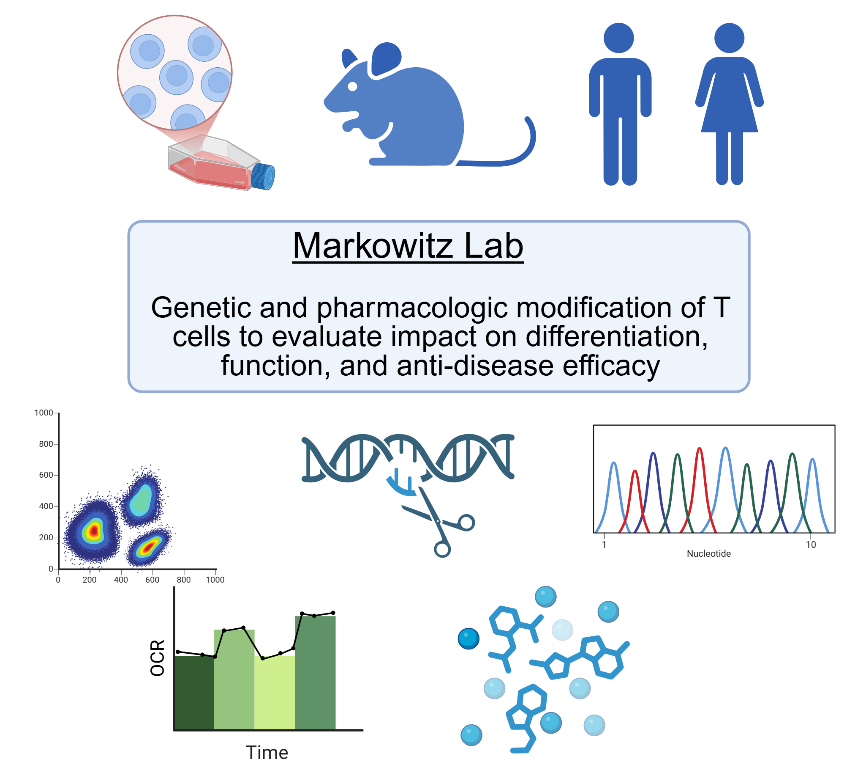
Research programs in the lab focus on using mouse models and human patient samples to address critical questions on the regulation of cellular differentiation. A primary focus of the lab is on metabolic control of function, downstream repercussions of activity on other cellular processes including transcription and epigenetic modification, and compensation upon interruption. We leverage well-established methodologies and develop innovative platforms to allow more robust interrogation of both mouse and human cellular function, utilizing genetic and pharmacologic modification of T cells to evaluate the impact of target manipulation on function and anti-tumor efficacy. Current projects include:
-
Identification of key tunable metabolic nodes controlling T cell differentiation and function;
-
Investigation of the dynamic context-dependent importance of one-carbon metabolism on cellular fate;
-
Interrogation and modulation of the metabolic environment during TCR-T generation to shape product T cell phenotypes.