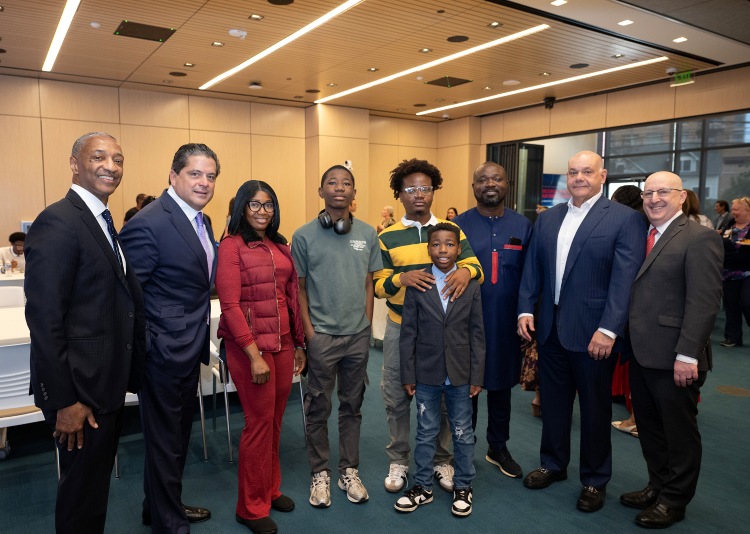
From Left to Right: William F. Tate IV, President, Rutgers, The State University of New Jersey; Mark E. Manigan, President and Chief Executive Officer, RWJBarnabas Health; Pewee Goumou, Bone Marrow Transplant recipient and his brother, Dirus Goumou, donor, and their family; Jack Morris, Chair of Robert Wood Johnson University Hospital’s Board of Directors and Steven K. Libutti, MD, FACS, William N. Hait Director of Rutgers Cancer Institute and Senior Vice President, Oncology Services, RWJBarnabas Health at the Pediatric Sickle Cell Disease Celebration.
NEW BRUNSWICK, N.J October 1, 2026 – Pediatric patients treated for sickle cell disease through the Pediatric Bone Marrow Transplantation and Cellular Therapies Program at Rutgers Cancer Institute and The Bristol-Myers Squibb Children’s Hospital at Robert Wood Johnson University Hospital gathered with their families and care teams to celebrate a milestone once out of reach for many people living with the disease: more than one year since completing potentially curative treatment, with no evidence of active disease.
The patients are children and young adults ranging in ages from six to 22 years old and received either a bone marrow transplantation or novel gene therapy, two intensive approaches that can offer a cure or long-term freedom from severe sickle cell complications. The celebration, held during Sickle Cell Awareness Month at the Jack & Sheryl Morris Cancer Center, recognized the patients’ treatment journeys and the multidisciplinary teams who supported them before, during, and after treatment.
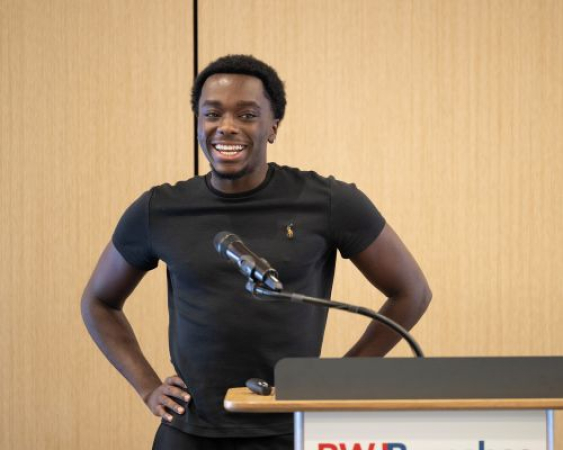
Nathaniel Salako, Gene Therapy recipient, takes the podium to share his experience with sickle cell disease and reflect on what life looks like today following treatment.
“Medical miracles don’t happen by accident. They happen when an expert team comes together around a common goal—in this case, the goal of removing, one patient at a time, the pain and stigma of a life with sickle cell disease,” said Mark E. Manigan, president and CEO, RWJBarnabas Health. “Today we celebrate both the spirit of these young patients and the partnership between RWJBarnabas Health and Rutgers University that is built on the promise of academic medicine and the ability to remove barriers and take medical breakthroughs from the lab directly to the bedsides of those hoping for a miracle.”
For patients and their families, reaching this milestone followed months of preparation, intensive treatment, and recovery. They endured long hospital stays, time away from school and loved ones, and periods of significant medical vulnerability, placing their trust in their care teams in the hope of emerging free from the pain crises, hospitalizations, and uncertainty that had shaped their lives.
At the reunion, patients and families shared reflections on life after treatment, while clinicians recognized the nurses, pharmacists, social workers, child life specialists, care coordinators, and other professionals whose work supports each treatment journey. Program leaders also encouraged families affected by sickle cell disease to speak with their care teams about whether evaluation for advanced treatment may be appropriate.
“It’s like a miracle,” said Ola Kunle-Lawanson, mother of six-year-old Tiara, who received bone marrow therapy. “I can see the difference. She has more energy, she’s playful—you can see her being a six-year-old finally.”
Before treatment, Tiara’s childhood was repeatedly interrupted by fatigue, illness, hospital stays, and blood transfusions. Her older brother, Kitan, was a bone marrow match and donated the cells used for her transplant. Today, Tiara is back in school and has not experienced a sickle cell pain crisis since treatment.
The Pediatric Bone Marrow Transplantation and Cellular Therapies Program provides advanced treatment options for children, adolescents, and young adults with cancer and blood disorders. The program was dedicated in 2024 and is one of the only programs in New Jersey focused on advanced life-saving treatments for children with cancer and blood disorders.
Delivering these highly complex treatments safely requires specialized clinical expertise, advanced infrastructure, and coordination across numerous disciplines. Through Rutgers Cancer Institute, New Jersey’s only NCI-designated Comprehensive Cancer Center, and The Bristol-Myers Squibb Children’s Hospital, patients and families can access this comprehensive level of care through one integrated program close to home.
The program is supported by newly renovated spaces designed specifically for transplant and cellular therapy care at The Bristol-Myers Squibb Children’s Hospital, a nationally ranked 2025–2026 Best Children’s Hospital by U.S. News & World Report. This highest level of acute care requires a very specialized multidisciplinary team that guides patients and families through evaluation, treatment, and recovery.
Sickle cell disease is an inherited blood disorder that can restrict blood flow and oxygen delivery, resulting in severe pain, anemia, infections, organ damage, repeated hospitalizations, and a shortened life expectancy. The disease disproportionately affects Black communities; in the United States, more than 90% of people living with sickle cell disease are Black or African American.
“Rutgers’ partnership with RWJBarnabas Health brings together research, education, and clinical care in service of New Jersey families,” said William F. Tate IV, President of Rutgers, The State University of New Jersey. “The remarkable progress represented by these courageous patients reflects both the scientific advances transforming sickle cell treatment and the extraordinary work required to make those advances available to the patients who can benefit.”
Bone marrow transplantation has been used to treat sickle cell disease for decades and can be curative for some patients but typically requires a sibling donor who does not have sickle cell disease and is tissue match to the patient. A Sickle Cell Trait or Carrier sibling can be a donor. Gene therapy is a newer, revolutionary treatment that offers an option for some eligible patients who do not have a matched donor by using their own blood-forming stem cells. The cells are collected and modified in a laboratory, and patients undergo high-dose chemotherapy to clear space in the bone marrow before the modified cells are returned through an infusion.
“Gene therapy has expanded what we can offer patients who previously had very limited curative options,” said Niketa C. Shah, MD, Chief of Pediatric Bone Marrow/Stem Cell Transplantation and
Cellular Therapies at Rutgers Cancer Institute and The Bristol-Myers Squibb Children’s Hospital. “BMT and gene therapy treatments are complex and require a significant commitment from patients and families, but they have the potential to reduce or eliminate the pain crises, hospitalizations, and daily limitations from sickle cell disease. Today was a celebration of how far each patient has come and of the teams who helped them get there.”
The U.S. Food and Drug Administration approved the first two cell-based gene therapies for sickle cell disease in December 2023 for certain patients age 12 and older. In July 2026, one of the gene therapy treatment was also approved for sickle cell disease patients ages 2 to <12-years. The approvals marked a new chapter for a disease that affects approximately 100,000 people in the United States.
“Advanced therapies only fulfill their promise when patients can access the expertise and infrastructure needed to deliver them safely,” said Steven K. Libutti, MD, FACS, William N. Hait Director of Rutgers Cancer Institute and Senior Vice President, Oncology Services, RWJBarnabas Health. “This program builds on our shared commitment to bring research-based treatment and comprehensive support to children and young adults across New Jersey at the state’s only NCI-designated Comprehensive Cancer Center.”
About RWJBarnabas Health
RWJBarnabas Health is New Jersey’s largest and most comprehensive academic health system, caring for more than five million people annually. Nationally renowned for quality and safety, the system includes 14 hospitals and 9,000 affiliated physicians integrated to provide care at more than 700 patient care locations.
RWJBarnabas Health partners with its communities to build and sustain a healthier New Jersey. It provides patient-centered care in a compassionate manner and is the state’s largest safety-net provider and leader in addressing the social determinants of health. RWJBarnabas Health provides food to the hungry, housing for the homeless and economic opportunities to those most vulnerable.
RWJBarnabas Health’s commitment to enhancing access to care includes a transformative partnership with Rutgers University, including the Rutgers Cancer Institute — the state's only NCI-designated Comprehensive Cancer Center, and Rutgers Robert Wood Johnson Medical School.
RWJBarnabas Health is among New Jersey’s largest private employers, with more than 45,000 employees, contributing more than $7 billion to the state economy every year. For more information, visit www.RWJBH.org.
About Rutgers Cancer Institute
As New Jersey’s only National Cancer Institute-designated Comprehensive Cancer Center, Rutgers Cancer Institute, together with RWJBarnabas Health, provides patients access to the most advanced cancer treatment options including clinical trials close to home at our facilities throughout the state. Our groundbreaking cancer research is the engine that drives access to the most advanced cancer treatments, where our discoveries become your care.
About Robert Wood Johnson University Hospital
Robert Wood Johnson University Hospital (RWJUH), an RWJBarnabas Health Facility, is a 724-bed academic medical center in New Brunswick that is New Jersey’s largest academic medical center through its deep partnership with Rutgers Robert Wood Johnson Medical School and Rutgers Cancer Institute.
RWJUH is home to the Jack & Sheryl Morris Cancer Center and The Bristol-Myers Squibb Children’s Hospital at Robert Wood Johnson University Hospital, the top ranked Children’s Hospital in New Jersey in the 2026-2027 Best Children’s Hospital by U.S. News & World Report. RWJUH is recognized by U.S. News & World Report as a Best Regional Hospital for 2026-2027 and is ranked in the Top 100 Cancer Centers in the U.S. Centers of Excellence include heart and vascular care from minimally invasive heart surgery to transplantation, cancer care, stroke care, neuroscience, orthopedics, pediatrics and women’s health. As one of only three state-certified Level 1 Trauma Centers and the first designated Pediatric Trauma Center in New Jersey, RWJUH’s campus serves as a national resource in its ground-breaking approaches to emergency preparedness. For more Information visit us online at: www.rwjbh.org/newbrunswick